
Operational Resilience Is Not Business Continuity
Why Traditional Continuity Planning Falls Short
Executive Summary
Business continuity and operational resilience are often treated as interchangeable. They are not. Business continuity documents how predefined processes should be recovered after an interruption. Operational resilience determines whether an organization can continue delivering critical services when conditions are unclear, changing, or actively deteriorating. Confusing the two creates a gap between perceived preparedness and real capability.
Continuity planning has increasingly become compliance-driven. This assessment reflects a pattern observed through reviews of existing continuity programs and recurring conversations with practitioners responsible for maintaining them, including at professional events and industry forums. In practice, many organizations maintain formally approved continuity plans while still experiencing significant disruption. Industry continuity surveys consistently show that many organizations experience major operational disruptions even when continuity plans are formally in place, highlighting the gap between compliance and effective protection. When disruption occurs, assumptions break down, dependencies surface unexpectedly, and decision-making slows when it should accelerate.
Operational resilience takes a different view. It assumes disruption will be messy, incomplete, and poorly timed. It prioritizes outcomes over rigid process recovery, treats decision-making as an operational capability, and relies on continuous validation of assumptions against operational reality.
This paper examines why traditional continuity efforts fall short, how disruption is actually experienced inside organizations, and what distinguishes those that adapt effectively under pressure. Business continuity remains necessary. Operational resilience determines whether it works.
Prepared on Paper, Exposed in Practice
Business continuity has long been treated as a necessary but inconvenient obligation. In environments shaped by efficiency targets, automation initiatives, constrained budgets, and delivery pressure, continuity planning is often reduced to documentation that satisfies governance requirements without demanding meaningful operational engagement.
The pattern is familiar. Plans exist. Reviews are completed. Exercises are run. The organization appears prepared. Yet when disruption occurs, those same plans struggle to guide action. Recovery steps depend on unavailable resources. Decision authority becomes unclear. Teams default to improvisation.
This disconnect is not caused by neglect or lack of effort. It reflects the challenge of applying static planning models within organizations whose operations, dependencies, and risk profiles change continuously. As organizations grow more complex, visibility into how work is performed becomes increasingly limited, even as documentation continues to expand. Preparedness becomes something that can be demonstrated on paper but not consistently relied upon in practice.
Defining the Difference: Business Continuity and Operational Resilience
Business Continuity
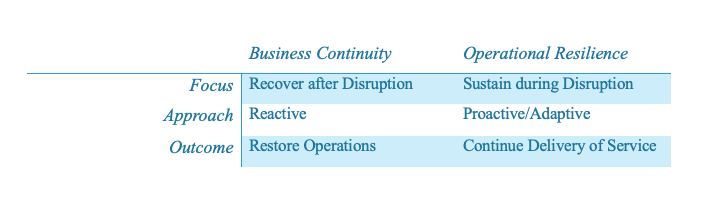
Business continuity focuses on the recovery of predefined processes following an interruption. It documents recovery steps, escalation paths, and time-based objectives, usually based on anticipated scenarios. In most organizations, continuity is governed centrally and assessed through audits, reviews, and periodic exercises.
This approach provides structure and satisfies governance expectations. It also relies on static assumptions. Plans tend to reflect how the organization is expected to operate, not how it behaves under pressure. As a result, continuity documentation often performs well in controlled settings and poorly during real disruption.
Business continuity remains necessary. On its own, it assumes a level of predictability that rarely exists when incidents unfold.
Operational Resilience
Operational resilience focuses on whether critical services continue when conditions deviate from expectations. It treats uncertainty, cascading effects, and incomplete information as normal features of disruption.
Resilient organizations prioritize outcomes over rigid process recovery. They understand how services are delivered across locations, teams, suppliers, and systems, and how those dependencies behave under stress. Decision authority, ownership, and communication are treated as operational necessities rather than administrative details.
Resilience is not activated during a crisis. It is built through continuous engagement with operational reality and regular validation of assumptions as organizations evolve.
Why the Distinction Matters
Organizations that rely solely on continuity planning often believe they are prepared until disruption exposes gaps documentation cannot address. Plans may exist, but critical dependencies between people, processes, suppliers, and systems remain poorly understood, local constraints are overlooked, and decision-making slows when clarity matters most.
Operational resilience does not replace continuity. It extends it. Continuity provides structure. Resilience provides adaptability.
Why Continuity Planning Breaks Down in Practice
Business continuity planning is typically designed and governed at a corporate level, where standardization, consistency, and oversight are necessary to manage risk across the organization. From this perspective, continuity is achieved once known interruption scenarios are documented and critical assets are accounted for.
In practice, this model struggles to reflect how organizations actually operate. Plans are often created with limited structured input from those closest to day-to-day operations, particularly as organizations grow and decision-making becomes more distributed. They correctly emphasize completeness and consistency while often neglecting usability under pressure. Validation exercises tend to reinforce existing assumptions instead of challenging them.
Over time, continuity planning becomes detached from operational change. Workflows evolve, dependencies shift, and informal practices emerge to meet performance demands. Continuity documentation, however, remains largely static. When disruption occurs, this mismatch becomes visible immediately.
The failure is often described as poor execution. More often, it is a planning model that prioritizes documentation over operational alignment.
The Real-World Gap: When Plans Meet Pressure
Operational disruptions are coordinated and escalated at a corporate level, but experienced most acutely at specific locations, within individual assets, and across teams operating under local constraints. These environments rarely resemble the standardized models assumed in centrally developed plans.
Teams adapt workflows over time to meet production demands and efficiency targets. In doing so, they form dependencies on suppliers, intermediates, informal processes, and key individuals. These adaptations improve performance under normal conditions but introduce complexity that continuity documentation does not capture.
When disruption occurs, this complexity surfaces immediately. Systems fail in combinations that were never anticipated. Recovery steps depend on unavailable people or information. The gap between documented response and operational reality becomes obvious.
Under pressure, teams improvise. Decision authority becomes unclear. Escalation slows rather than accelerates action. Leadership struggles to obtain a reliable picture of what is happening on the ground. Information arrives late or without context.
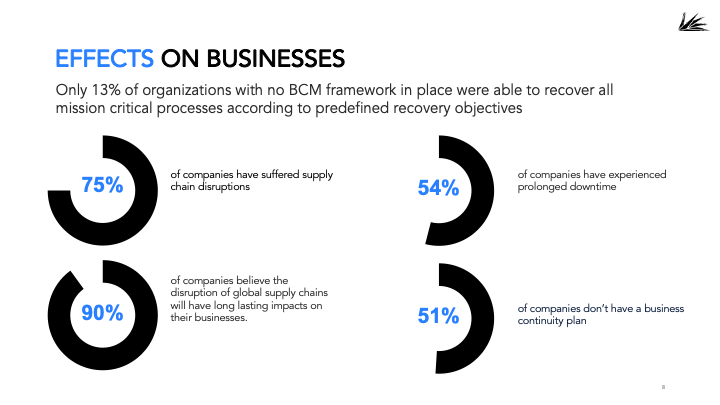
The consequences of this gap are not theoretical.
Approximately 40% of businesses affected by major disruptions never fully recover, and organizations without regularly tested recovery capabilities experience significantly longer downtime (industry continuity studies, 2022–2023). These outcomes are rarely caused by a lack of documentation, but by a lack of operational alignment.
What Operational Resilience Looks Like in Practice
Operational resilience is not a program or a framework. It is the result of how an organization understands and manages itself over time.
In practice, resilient organizations focus on protecting critical capabilities rather than attempting to recover every process exactly as designed. Priorities are established before disruption occurs, allowing teams to make deliberate tradeoffs instead of reactive ones.
Resilience is grounded in operational understanding. Dependencies are treated as dynamic relationships rather than static diagrams. Decision-making under pressure is designed intentionally, with clear ownership and shared situational awareness.
Rather than attempting to eliminate uncertainty, resilient organizations design for it. Assumptions are tested continuously, learning is incorporated into daily operations, and resilience does not quietly decay between incidents.
An Operational View of Building Resilience
Organizations that make progress on resilience change how they think about preparedness. It is no longer treated as a periodic exercise, but as an operational quality that must be maintained.
This requires engaging honestly with how work is performed, how decisions are made, and how dependencies evolve. It also requires accepting that operational reality will never align perfectly with corporate models.
This approach is less tidy than traditional planning. It is also more effective.
Practical Observations for Leaders
Leaders assessing preparedness should look beyond the existence of plans and ask harder questions:
Are critical capabilities clearly defined before disruption occurs?
Do plans reflect how work is actually performed?
Are operational dependencies understood, or discovered during incidents?
Is decision authority clear under pressure?
Are assumptions tested against reality, or reinforced through exercises designed to succeed?
Preparedness is not demonstrated by documentation. It is revealed by how quickly an organization can align and act when conditions change.
Conclusion
Business continuity remains necessary. It provides structure and a starting point for preparedness. It does not determine performance under pressure.
Operational resilience fills the gap between planning and reality. It reflects an organization’s ability to adapt as disruption unfolds rather than attempting to force events to conform to predefined scenarios.
Continuity Plans are important. Resilience is critical.
Further Reading & References
· OpsCentre. The Resilience Integration Whitepaper. (PDF) Operational Resilience Whitepaper – OpsCentre
· ARYZA. Operational Resilience vs Business Continuity (PDF) Operational Resilience vs Business Continuity PDF
· Davies Group. Operational Resilience Whitepaper. (PDF) Operational Resilience Whitepaper – Davies Group
· Regroup. Operational Resilience White Paper. Operational Resilience White Paper – Regroup
· BCI. Business Continuity vs Operational Resilience article.
· Federal Reserve. Sound Practices to Strengthen Operational Resilience.
· ISO. ISO 22300 – Security and resilience – Vocabulary.
· ISO. ISO 22301 – Business Continuity Management Systems.
